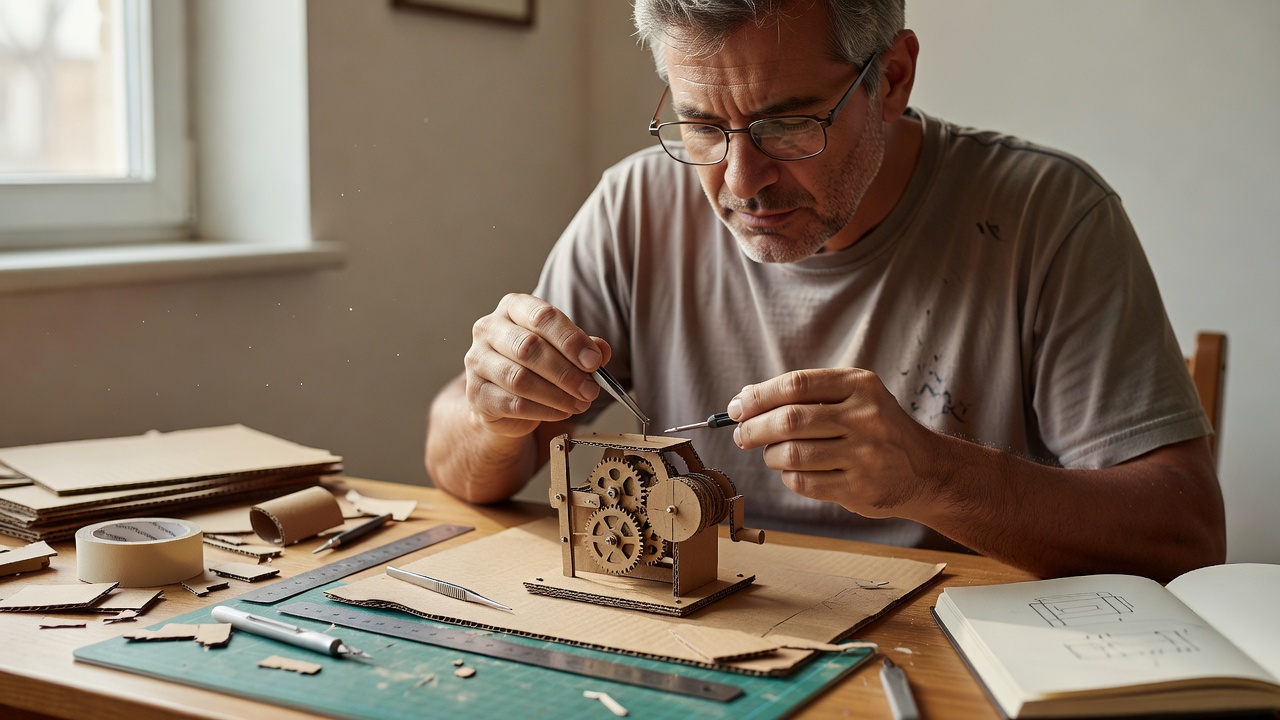
Puff Tinker Puzzl is an independent informational website about miniature puzzle builds and compact mechanisms. We focus on gravity tracks, magnetic sliders, small labyrinths and folding structures because each makes a different kind of movement visible.
Our approach is deliberately modest. Choose a manageable footprint, isolate one moving connection and keep the first version easy to alter. You do not need to turn an afternoon experiment into a product, a collection or a perfect photograph.
What a useful guide should explain
A material list is only the beginning. We aim to explain why a part needs clearance, where an adhesive joint might interfere and how to compare two tests without changing everything at once. Dimensions depend on the materials in your hands; examples are starting points, not guarantees.
We distinguish practical suggestions from product certification. A hobby enclosure is not automatically a safe toy. We do not claim that these projects meet ASTM F963, EN 71 or any other product-safety standard.
A wider shelf of small mechanisms
Mechanical curiosity has many neighbours. Henry Dudeney’s Amusements in Mathematics and Sam Loyd’s Cyclopedia of Puzzles offer historical puzzle perspectives. Martin Gardner’s Mathematical Puzzles and Diversions shows how a simple rule can support a surprisingly rich problem.
For hands-on inspiration beyond our specific builds, the Exploratorium in San Francisco, the Science Museum in London and the Deutsches Museum in Munich connect mechanisms with observation. The Exploratorium is a useful place to begin exploring that approach. These references are context, not endorsements, partnerships or claims that our projects reproduce their exhibits.
Independence and corrections
We are not affiliated with the museums, authors, standards bodies or product manufacturers mentioned here. The site does not sell kits or provide engineering certification. We do not use affiliate links on these pages.
If an instruction is unclear or a safety note needs attention, please prepare a correction message. Include the page address and the wording you are concerned about. We cannot inspect your workspace or guarantee a reply, but a specific description makes a correction easier to assess.
We celebrate a joint that runs more smoothly, not a claim that the whole workshop is finished.