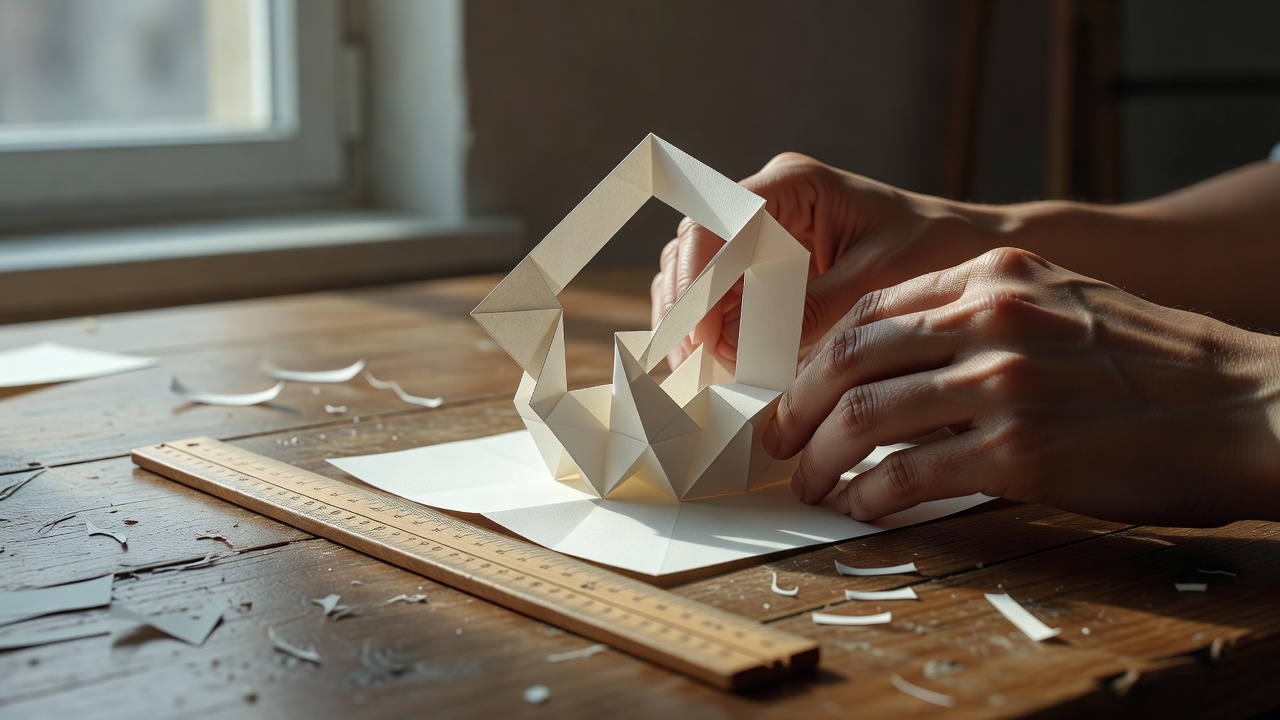
Paper mechanisms are a good entry point when desk space is limited. They need no loose rolling pieces and no magnets, and the tools can fit in a small envelope. Their apparent simplicity is useful: if a fold resists, you can usually see which layer, attachment or crease is asking for more room.
Begin with a single hinge and a parallel pop-up step. The aim is not a miniature sculpture. It is an assembly that opens, pauses and closes without forcing the base out of shape. Once that movement is dependable, it can support a small scene, a reveal panel or a pocket-sized mechanical puzzle.
Find the fold the sheet prefers
Cut two similar test strips at right angles from the same sheet. Fold each across its middle and compare how evenly it bends. Paper often folds more cleanly along its grain direction, though coatings and fibre mixtures can complicate the result. The test is more useful than guessing from the sheet’s appearance.
Align the corners first, hold them in place and work the crease outward from the centre. Make a firm but not crushing pass with the blunt tool. Repeated aggressive rubbing can polish, thin or crack the surface. If the stock splits, try lighter material before pressing harder.
Cut a parallel pop-up step
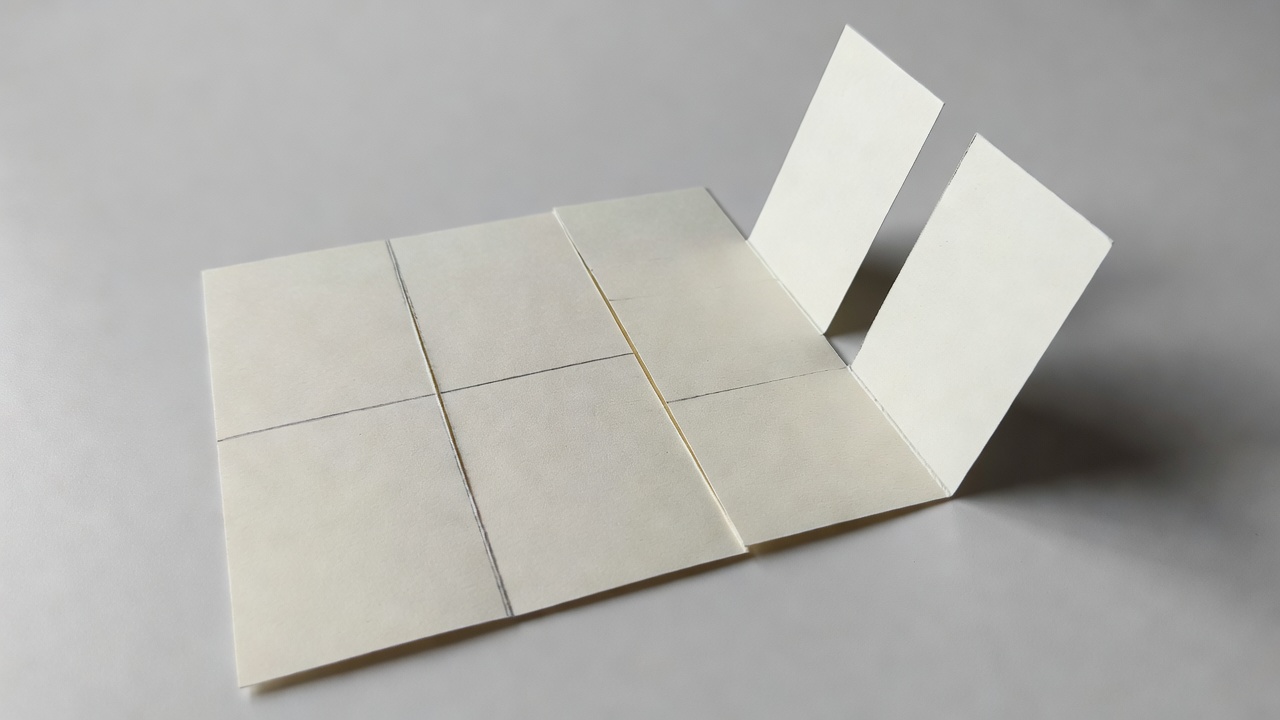
Fold a rectangular test sheet in half. With the sheet still closed, make two short, equal, parallel cuts inward from the folded edge, passing through both layers. Leave a broad strip between the cuts and plenty of uncut paper around them. Stop both cuts at the same depth.
Fold that strip over along a line joining the cut ends, crease gently, then unfold it. Open the base partway. Push the strip inward so its original centre fold reverses direction. Close the base slowly while guiding the strip inside, then reopen it. You should see a simple step projecting from the central fold.
Watch the closing envelope
The space a mechanism needs while moving is its motion envelope. A tab may look neat when fully open but still collide with another layer halfway closed. Move the base slowly through its full range and watch the tab edges. Stop if the paper buckles rather than letting the crease act as a lever.
Try a second sample with a shallower cut and compare the projection. Change one dimension at a time. Mark each sample lightly so you can remember which adjustment produced the smoother movement. This small collection of tests becomes a more useful reference than one ambitious piece that never quite closes.
Add weight and layers cautiously
Only after the plain step works should you attach a small decorative panel. Keep it light and inside the closed outline. Dry-position it first and cycle the mechanism before gluing. Adhesive belongs on fixed attachment areas, not across a hinge or into the moving clearance.
Thicker card is not simply stronger paper. Its thickness changes where surfaces meet, and stacked layers need additional room. A mechanism that closes neatly in thin paper may buckle in heavy stock. Rebuild a small test in the final material rather than transferring every dimension without checking.
Give a stubborn fold a reason to improve
The pop-up twists as it opens
Compare the cut lengths and the crease joining their ends. An unequal pair can pull the tab sideways. A fresh symmetric test is often quicker than repairing a stretched sample.
The base will not close flat
Look for an incorrectly reversed centre fold, added layers that collide or glue across a moving crease. Do not force the base shut under a heavy book.
The hinge wears out quickly
A crease is a flexing part, not an everlasting joint. Try a more suitable paper, reduce unnecessary cycling and keep the geometry from pulling sideways.
A shelf for further curiosity
Robert Sabuda and Matthew Reinhart demonstrate how paper engineering can support storytelling. David A. Carter and James Diaz explore mechanism families in The Elements of Pop-Up. For folding rather than cut pop-ups, Robert J. Lang’s Origami Design Secrets and Akira Yoshizawa’s work offer different paths into precision. These are independent references, not affiliations or required purchases.
A small improvement in alignment can do more than a stronger sheet.